Sunday, May 15, 2016

Week 7: Neurosci + Art


The most interesting point from this week’s lesson can definitely be said as the concept of “unconsciousness” and the different influences to some unseen religious aspects. As Professor Vesna covered, the in-depth research of neurology becomes eminent especially with Franz Joseph Gall’s concept of phrenology, where mental functions were said to be localized and one’s feelings reflect such localized functions. Although Gall touched on the topic of 8 senses in which humans had where other animals did not, this idea went perpendicular to Gall’s era where it was highly religious in Judo-Christianity. Similarly, prominent researcher Mark Cohen also touches that around this time, there existed such different standards of neuroscience than of today; that even people believed criminals have bumps on heads specifically where the brain had localized characteristics.

A more modern perspective comes into picture when Carl Jung was said to introduce the idea that every person has some psychic culture in his unconsciousness, as Professor Vesna describes. In Carl Jung’s article, in which the language was personally heavy to read, Jung states that the body lays claim to equal recognition, that it exerts the same fascination as a psyche. 

Jung’s ideas reflected a more modern view of the spiritual sense within science, somewhat similar to many concepts introduced by various deitic religions. In its modern transitions of the neuroscience research, many inventions and experimentations- both inside laboratories and outside- are conducted such as Mark Cohen’s inverted goggles testing brain’s adaptation abilities.

In Swann’s Hypothesis article, author Max states that researcher Lehrer found that writers and musicians consistently lead the way to new theories with inspiration while scientists mop up with hard data. In this, we can even see the correlation of artistic activity to scientific research, as scientific research is not always conducted in laboratories; they are brought from the everyday life, with many inspirations and products of everyday lifestyles- much including art. As Frazzetto and Anker states, the interaction between art and science offers an opportunity to make the scientific community and the public aware of the social and ethical implications of the scientific advances in neuroscience. As Neuroscience reveals individuality, there is no way that individuality can precede without putting Art into the picture! Although so many theories are introduced and experimented for every day, as it has been for the last century, the true product comes from its interaction with art.


----------------------------------------------SOURCES------------------------------------------------------

Brain and Art Img. "Psychology Brain Art - Danasojak." N.p., n.d. Web. 15 May 2016.

Cohen, Mark. "Neuroscience-Mark Cohen.mov." YouTube. YouTube, 12 May 2012. Web. 15 May 2016.

Frazzetto, Giovanni, and Suzanne Anker. "Neuroculture." Nature Reviews Neuroscience Nat Rev Neurosci 10.11 (2009): 815-21. Ucdesma. Web. 15 May 2016.

Jung, Carl. "The Spiritual Problem of Modern Man." Collected Works of C.G. Jung, Volume 10: Civilization in Transition (n.d.): n. pag. Ucdesma. Web. 15 May 2016.

Max, D. T. "Swann’s Hypothesis." The New York Times. The New York Times, 03 Nov. 2007. Web. 15 May 2016.

Phrenological Img, Dale Michels. "Phrenological Phacts." Fine Art America. N.p., n.d. Web. 15 May 2016.

Neuroculture Img. "Is Neuroculture a New Cultural Revolution? | OUPblog." OUPblog Is Neuroculture a New Cultural Revolution Comments. N.p., 26 Nov. 2015. Web. 15 May 2016.

Vesna, Victoria, narr. “Neuroscience Art Lectures I-III.” N.p., . web. 16 May 2012.

Sunday, May 8, 2016

Week 6: Biotech + Art

Although this week’s  topic of Bio art was and is still somewhat distant to me, the modern approach to cultivating any form of nature into something so creatively intriguing was indeed surprising and interesting. As Professor Vesna mentions in her lecture, Technology has relations to this week’s topic as well as it is generally expanding into bodies and environments, for science and for art.
Looking at Eduardo Kac’s “Transgenic Art” where he experimented with rabbits to make that unnaturally translucent in the dark, there seemed to be many contrasting approaches to the use of Animal experimentation not only within the field of his scientific input, but more because he is using it for art.

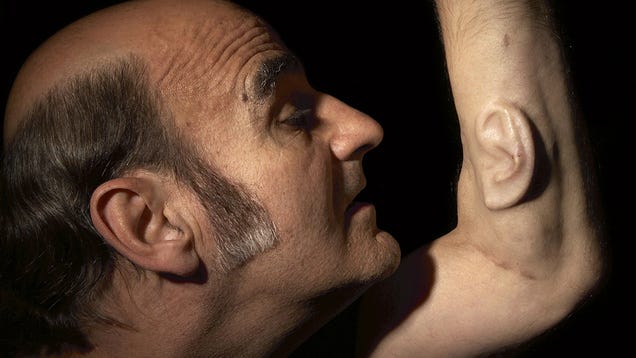
"Ear on Arm" by photographer N. Sellars
So what makes a legitimate standard in judging one’s artwork, or experimentation,  unethical or inappropriate? Related thereto, in Ellen K. Levy’s article; Philosopher Haraway questions how psychic and commercial investments are to be made when lines among human, machine, and organic nature are highly permeable and eminently revisable.

Personally, after much research I have come to add a statement that although animal experimentation is generally looked down upon in its “unethicality” of abusing a living object, the practice is acceptable when it has a tangible benefit to the lives of the human beings. According to, a experimentation like that of Eduardo Kac with the GFP Bunny where it seems to have no medical or physical benefit to human beings will be prone to much opposition. Similarly, Kathy High recognizes that although she is not against animal scientific research, she believes only certain kinds of research should be conducted.

Summer residency in Bio art at SVAAt the end, as Chris Kelty says in his article- Creativity breeds creativity, and innovation breeds innovation. Therefore which method the innovation is conducted should not be focused on, as there seems to be no linear form of accumulation as to what standard one’s work is determined as supposedly an “outlaw”. 


I come to understand that the ambiguity remains in determining one experiment’s righteousness over another when using animal experimentation, as the same argument can cause hindrance to an experiment actually crucial for a discovery for science. So should we set down the rules to determine the ‘rights’ from ‘wrongs’ in Bio-art and their experimentation? I can only assume that Bio art- because it is so closely linked to biological and medical sciences- we can only respect the ambiguity and strive upon further innovations to expand.


Eduardo Kac's GFP Bunny

--------------------------------------------------------------------------------------------------------------

 Sources

High, Kathy. "The Politics of Empathy." Embracing Animal. N.p., n.d. Web. 07 May 2016.

Kac, Eduardo. "GFP BUNNY." GFP BUNNY. Kac Web, n.d. Web. 06 May 2016.

Kelty, Chris. "Meanings of Participation: Outlaw Biology?" Journal of Science Communication (2010): n. pag. Web. 07 May 2016.

Levy, Ellen K. "Defining Life: Artists Challenge Conventional Classifications." (n.d.): n. pag. Web. 08 May 2016.

Marcredi, Janique. Image. "Rencontre(s) Avec Edouardo Kac." NUMEDIA-ART. NUMEDIA-ART, 2007. Web. 8 May 2016.

Person, and George Dvorsky. Image. "7 Bio-Artists Who Are Transforming the Fabric of Life Itself." Io9. N.p., 24 June 2013. Web. 09 May 2016.

Strijip, Mu. Image. "Body of Matter: Body Based Bio Art and Design." Bio Art & Design Award. N.p., n.d. Web. 08 May 2016.

"Summer Residency in Bio Art at SVA | Art & Education." . Image. Art & Education. N.p., n.d. Web. 09 May 2016

Vesna, Victoria. "Biotech + Art Lectures." UC Online. Professor Vesna, n.d. Web. 08 May 2016.


Thursday, May 5, 2016

Extra Credit event 1: LACMA Pavilion of Japanese Art

Myungjae Song, April 22, 2016; Women security worker in uniform in the back
For my First extra-credit-event, I visited the LACMA museum and checked out the different exhibits. For this post, I want to elaborate on one specific exhibit of “Pavilion for Japanese Art”, which I found very interesting and applies to the Math+Art perspective from Professor Vesna’s lecture.
By each era the sophistication of depth, actuality, expression, proportions tangibly advanced. Many sculptures and art works before the 10thc developed the most contrasting advancement towards realistic life-like features of the subjects. However, what was most interesting for me were the Japanese Traditional-style Screens, in which the artistic painting depicted pivotal moments in the history of Japan.

These screens were useful in forming a wall-like space for the aristocratic Japanese who actually were able to afford owning them, however symbolized much historical and religious perspectives, literally. For example, the Screen depicting the Genpei-War was created in the 16-17th century, which was around the time when the Western civilizations utilized different baroque art-style ideas using vanishing points, and perspectives.

Battle of Ichi-no-tani; Genpei Wars, Japan, circa 16-17th c


Similarly, however somewhat differently, the screens portrayed a war scene with calculated proportions of waters, architecture, forest, and actual people. These proportions were believed to have derived from the Buddhist belief re Yin and Yang, however while still serving the technological perspective in daily usage.
Jomon, Rope Pattern Pottery

This Screen was similar to the Flatland idea where three dimensional setting was expressed on a two dimensional space, just as many Western artists did around this time. I would recommend this exhibit to my class, as I believe my DESMA classmates would be able to recognize and be wowed by such mathematical perspectives of the different sculptures and in the gallery.

Moreover, Japan's much pre-modern period displays of artworks had much influence from the usefulness of the artists. Decorative art was founded mostly for Jomon and Yayoi period pottery, in which the artists configured ways to utilize the technological perspectives of such pottery objectives while still demonstrating much creativity in its beautiful visuals.

Screen depicting Rice Cultivation through the Four Seasons, Japan, circa 1700-1725


Midterm Project

Here is my Midterm Project on the "Art Therapy Diagnosis Machine" submitted May 1, 2016, uploaded here for your view! Enjoy!


Friday, April 29, 2016

Event 1: Los Angeles Asian Film Festival

For my first event, I attended the Screening of VC_Digital_Posse_2016, held by the Los Angeles Asian Pacific Film Festival.

The night of my attendance [04/24/2016], this event show-cased 9 short films created by rising talents, surrounding the theme of Asian-Pacific Heritage. Some films also focused on the general and simple theme of "heritage" within their own culture, not just of the Asian Pacific.                                 

My favorite film  of the event was the "Hand Fart" created by Travis Ashkenazy &Stanley Wong. This film is a humorous depiction of the symbolic representation of having the fate of your life in your own hands. [http://laapff.festpro.com/films/section/shorts_program_vc_digital_posse_ver_201]
At the end of the screening, the filmmakers all came up to the stage to describe the process of creating their films. Each filmmaker was assigned to deliver a message and theme through their five-minute movie (sometimes more), and keep the audience entertained with the keen calculation and usage of video-editing. Camera-technology was utilized at its outermost potential to bring out the best artistic result of their projects. In order to create their one piece of 5-minute short-movie, these filmmakers put weeks in editing every little sound effect, visual effect, and sentimental effect of each second. 

This was where I was able to learn that technology was utilized to create art, and that the art conclusively expressed the greater purpose of human mind. Specifically mentioning the "Hand Fart" film, the filmmakers stated that they had to use the real set of a hospital scene with real medical instruments in order to gain the depth and true humor of the film. 
Through this event, I was able to think deeper into the third world as described by C.P. Snow in the Third Culture, as mentioned in our class week 1. Contrary to my disagreements back in week 1, I came to realize that the world of technology was essentially like the middle bridge connecting different worlds of art and different science. Technology was used to create the filmmaker's artistic expressions, in subjects and genres of sciences. Moreover, I came to realize that anything can be expressed through art like science/math, and art can express anything and everything. I believe everyone will enjoy the event, it is not only interesting but also very eye-opening.


Sunday, April 24, 2016

Week 4: Medicine+Technology+Art


"Yuriko Yamaguchi: Interconnected in Art, Nature,
Science and Technology" Installation image. "
Medicine, Technology, Art?? I would have never thought of combining these three completely different genres under one umbrella. However, despite the personal lack of experience I had within my limited knowledge about sciences, I came to find out that Science was always depicted as Art, and that the standard was only changing from a more traditional perspective to a more modern one.

In her lecture, Dr. Vesna indicates that Medicine was traditionally considered as art, and the use of tools/technology within medicine was not to be practiced by “true doctors”. On the other hand, Dr. Vesna describes the drastic transitioning of ideas as Modern days the Medical Tools/technology is practiced by “true doctors”, and that those mechanisms are actually artistic. A foundation cultural-transition of medicine is also expressed in Peter Tyson’s article where Dr. David Graham points out that the traditional “Oath” of Medicine was heavier as a sort of a covenant binding to an inherent treaty in medicine.  However, Graham compares such traditionalism to modernism as many modern oaths have more bland nature with a generalized concept of “best wishes” about them.
MRI art- Bunge Lab Berkelely

Virgil Wong's 3D Anatomy App
Although Graham’s translations of the cultural transition was rather pessimistic, we can definitely understand that the modern scientists definitely have a contrastingly different interpretation of Medical Science and technology expressed artistically, disparate from the traditional ideas. Silvia Casini realistically compares modern MRI with the concept of the Portrait art, as having “parallel looks”; with both being performative, but resistant to being regarded as transparent windows. However, the two diverse yet parallel genres have different artistic values as MRI has a more “acoustic” artistic expressions but the Portrait has a more “visual” artistic expression.

Moreover, Donald E. Ingber goes further into interconnecting Medical Science with Art as Ingber states that the design of the organic structures of the natural life creates a design of natural order so complex and artistically significant, that it shall be considered visually artistic. By directly implying the natural order of science to art, Ingber completely interrelates two such distinct concepts under one translational bubble.

Conclusively, I came to realize that art can be found in basically any fundamental and physical existence in the world. As Virgil Wong used artistic 3D Anatomical bodies to fulfill both fields of Arts and Sciences through his works, modern technology opened a new era for Medical Sciences within its bond with the beautiful outlook as “Art”.


-------------------------------------------------------------------------------------------------------------
Sources

Bunge, Silvia A. "MRI Recollection, Bunge Lab." Bunge Lab, Building Blocks of Cognition. N.p., n.d. Web. 24 Apr. 2016. <http://bungelab.berkeley.edu/principal-investigator/>.

Casini, Silvia. "Magnetic Resonance Imaging (MRI) as Mirror and Portrait: MRI Configurations between Science and the Arts." Configurations 19.1 (2011): 73-99. Ca Foscari Universita Di Venezia. Web. 24 Apr. 2016.

"Emory University School of MedicineRad Report." 31st Annual Weens Lecture: Health Time Machines- How a 3-D Selfie Can Help You Get Healthy. N.p., n.d. Web. 24 Apr. 2016. <http://radiology.emory.edu/about/rad-reports/stories/2014/08/weenslecture/index.html>.

Ingber, Donald E. "The Architecture of Life." Sci Am Scientific American 278.1 (1998): 48-57. Web. 24 Apr. 2016.

Tyson, Peter. "The Hippocratic Oath Today." PBS. PBS, 27 Mar. 2001. Web. 24 Apr. 2016. <http://www.pbs.org/wgbh/nova/body/hippocratic-oath-today.html>.

Vesna, Victoria, Dr/Prof. "Medicine Lectures." Course Login UCLA Desma9. Victoria Vesna, n.d. Web. 24 Apr. 2016. <https://cole2.uconline.edu/courses/484297/pages/unit-4-view?module_item_id=8599397>.

Wong, Virgil. "Virgil Wong | Artist and Health Cognition Researcher, Columbia University | Cofounder and Inventor, Medical Avatar." Virgil Wong. Virgil Wong, n.d. Web. 24 Apr. 2016. <http://virgilwong.com/>.

Yamaguchi, Yuriko. "Yuriko Yamaguchi." Koplin Del Rio. N.p., 2007. Web. 24 Apr. 2016. <http://www.koplindelrio.com/content/yuriko-yamaguchi>.


Sunday, April 17, 2016

Week 3: Robotics+ Art


After this week’s reading, I began to think that Technology and industrialization may have actually triggered a new world, with new functions, and new perspectives. However, is “New” always so good?

Ford Assembly Line, 1920s
Primarily, Mass production stands as one of the most influential impact of the utilization of Technology in the practical society. Although a symbolic introduction of technological practicum of this mass production is known to be Ford’s technology of Assembly Lines, Dr. Vesna adds in her lecture that the First mass production was the Printing Press. Printing Press should be seen as the first mass production practice as it benefited, or at least effected, the lifestyles of all people in all classes and genders; not just the rich who were   primarily effected by Ford’s first Assembly Lines. However, was this new technological influence in the society welcomed?

Douglas Davis states in his article that Original and reproduction in this society virtually no longer withholds a clear conceptual distinction between one another. If the production of replicas and copies, and mass production was so conformed into the use of the society, I would have initially assumed that since the society allowed for such conformation, then people probably thought positively of it. However, this assumption is contrasted by Walter Benjamin as he expresses in his article that there exists an imperialistic warfare in the society where it began within the discrepancy between the means of production and their “inadequate” utilization in the process of production, which ultimately sums up to negatively affect unemployment and Lack of Markets. So I came to understand that technology has its toll in different perspectives in the society. Technology is becoming significant in propelling the market, but taking away employment of humans.


Thinking deeper into this topic, I thought of two movies that reflect the contrasting ideas of the society towards technology, although both published in 2008. “Eagle Eye” starring Shia Lebeouf seems to clearly demonstrate the ultimate fear of the people with the drastically growing use and complexity of technology. In contrast, the famed “Iron Man” starring Robert Downey Jr. becomes a more positive outlook of the use of technology as protagonist heroically saves the world from bad humans. Although there was, is, and will still exist contrasting outlooks to technology and industrialization in the society, the inevitable presence of Technology is increasingly being defined and expressed through Art.


Sources

Benjamin, Walter. "The Work of Art in the Age of Mechanical Reproduction." Stardom and Celebrity: A Reader (1936): n. pag. Web. 17 Apr. 2016.

Davis, Douglas. "The Work of Art in the Age of Digital Reproduction (An Evolving Thesis: 1991-1995)." Leonardo 28.5 (1995): 381-86. JSTOR. Web. 17 Apr. 2016.

Eagle Eye. Dir. D. J. Caruso. Prod. Alex Kurtzman, Roberto Orci, and Patrick Timothy Crowley. By John Glenn, Travis Adam Wright, Hillary Seitz, and Daniel McDermott. Perf. Shia LaBeouf, Michelle Monaghan, and Rosario Dawson. DreamWorks SKG, 2008.

Iron Man. Dir. Jon Favreau. Prod. Avi Arad and Kevin Feige. By Mark Fergus, Hawk Ostby, Art Marcum, and Matthew Holloway. Perf. Robert Downey, Terrence Howard, Jeff Bridges, and Gwyneth Paltrow. Paramount Pictures, 2008.

Robotics Lectures. Dir. Victoria Vesna. Perf. Victoria Vesna (Dr./Prof.). Course Login. UCLA Online Website DESMA 9, n.d. Web. 17 Apr. 2016.